
Visible Failure Is the Good Kind
The failure you can see is the one you can still fix.

A few weeks ago my civil engineering classmates started texting about 235 East 42nd Street, the former Pfizer headquarters near Grand Central being converted into the largest office-to-residential project in the country.
Two columns on the 21st floor buckled under the weight of the floors still going up above them. A steamfitter named Sean Dow, working a floor above, noticed cracks in the concrete, walked down a level, and found a group of contractors staring at a column bent so far it looked ready to snap. He called his foreman. The building evacuated. Floors sagged a few inches. The city cleared a several-block “frozen zone” for most of a day. Nobody was hurt.
Compare that to Surfside, Florida in 2021. Most of Champlain Towers South came down while the building slept. No bent column for anyone to photograph and evacuate around. No hour to get people out. Two of the building’s three sections were gone within seconds. Ninety-eight people died.
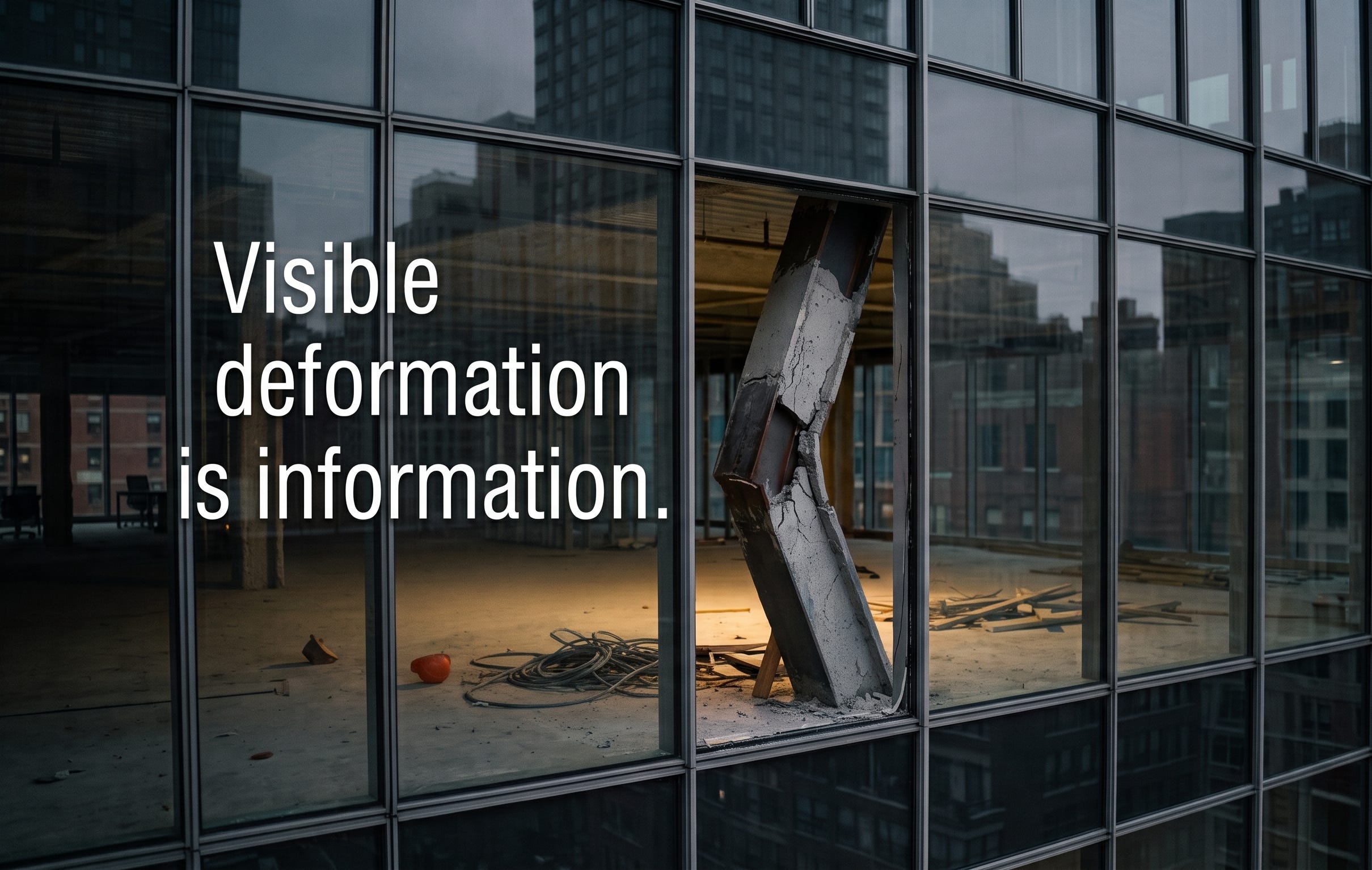
Visible deformation is information.
Both buildings failed. That’s not in dispute. What’s different is the failure mode. 235 East 42nd Street’s column bent before it broke, slowly enough for a steamfitter to see it, name it, and get people out. Surfside gave no equivalent signal. The failure stayed invisible until it wasn’t, and by then there was no time left to read it.
One left room to act. The other didn’t.
Inside companies, the same distinction shows up constantly. Projects stay green until load stress-tests them.
I worked at a company that spent roughly two years on a marquee initiative to migrate internal data workflows to a low-code platform. Vendor costs, staff labor, design sessions, migrations, learning a new tool: somewhere between twelve and sixteen million dollars before anyone did the math in one place.
Quarter after quarter it got greenlit. Smaller teams cut over without incident. HR used it. Facilities used it. On paper, momentum.
Then a department of hundreds of users with thousands of daily transactions migrated.
Page loads stretched to ten minutes. The system hadn’t bent. It broke.
Same pattern. Everything looked fine until volume arrived, and then it broke all at once.
What followed was forensic, not preventive. How much had we already spent? What was left on the timeline? Could the architecture hold the full user base even if we kept going? The answers came after things broke, not before.
The project was sunset. Internal users were left to find their own workarounds.
Yellow flags appeared throughout the project. They never got read as failure: maintenance costs weren’t in the business case; the timeline had quietly run past double the original estimate; the build-vs-buy case was quickly thrown out because no vendor could accommodate the team’s 35-step process with handoffs across four teams.
The team had answers: the tools were easy enough for the users to own the maintenance; the learning curve was steeper than expected, but estimates were now solid; and the team workflows were simply too unique.
None of that was hidden. It was sitting in status decks every quarter, next to a green light. Everyone could see it. Nobody took the time to look underneath.
Until the 10-minute page loads.
Watch what happens in the public response to Manhattan.
The developer, MetroLoft, is getting reamed. There’s a criminal case forming, while MetroLoft’s founder, Nathan Berman, called the failure “a typical construction mishap” and said the building was “well engineered, well thought through and well executed, with the exception of those two columns that could not take the load.” Local news reported the “project was hit with six major DOB violations, racking up more than $32,000 in fines.” MetroLoft should have been in front of the Department of Buildings earlier with a real remediation plan. But it’s worth remembering: this time, the deformation gave everyone time to act. Nobody died.
Here’s the trouble: if visible failure gets punished, the next rational move is to hide the work in progress. Imagine blackout curtains in front of the windows... no one would see the buckled column.
Organizations run the same incentive structure on smaller scales. A project with executive sponsorship, vendor spend already sunk and a quarterly greenlight rhythm doesn’t want early deformation. It wants continuity. An ops concern about maintenance math reads as noise. A build-vs-buy question reads as not understanding how unique we are. The status stays green because nothing has broken yet.
Given the choice, visible failure is the good kind.
We wait for load to prove what was already structurally wrong, then treat the failure as new information.
The cheaper failure is the one that buckles before it fails. You need systems, and cultures, that make that visible early. Not dashboards that stay green until ten-minute page loads force the conversation. Not marquee logic that discounts deformation because the small-team migrations looked fine.
Both buildings failed. Only one gave anyone time to fix the problem.
I’m Clare Hawthorne. I founded OxerLine Advisory to fix friction at the seam between technology and the business. If this is something you’re facing, let’s chat.